‘It takes more than just knowledge to create impact’
May 20, 2026
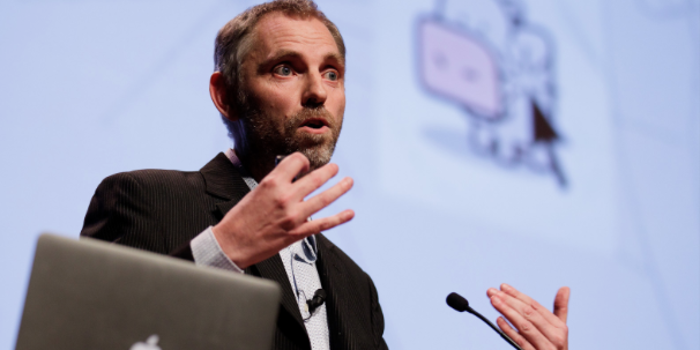
Harry van Vliet (Amsterdam University of Applied Sciences) on impact in practice-oriented research
Since its establishment in 2022, the Faculty of Impact has been open to candidates from all Dutch research institutions. Remarkably, applications from universities of applied sciences lag significantly behind those from universities and medical centers. ‘Yet there is definitely potential in our sector’, says Professor Harry van Vliet of the Amsterdam University of Applied Sciences. His appeal: we need to move towards a broader definition of impact.
Since 2019, Harry van Vliet has been a professor in Continuous Effects of Practice-Oriented Research at Amsterdam University of Applied Sciences. And it soon becomes clear in our conversation that the term ‘continuous effects’ was not chosen at random. He believes that the term ‘impact’ currently has too narrow a definition in academia. In his view, it is still too often assessed using the traditional scale of what he calls the linear model: something is devised in academia, then brought to society as a concrete service or tangible product, yielding a certain return. ‘From knowledge to skills to the till’ was once the motto of former minister Maxime Verhagen. Although that traditional model has long since been contested in the broader debate on impact and valorisation, Van Vliet notes that many indicators in the assessment of research proposals still rely heavily on it. ‘That way of looking at things does not do justice to practice-oriented research’, he believes.
More than just economic returns
He would therefore like to define impact more broadly and uses the term continuous effects to do so. Although, of course, it is not the name that matters to him, but what it entails. According to Van Vliet, making an impact happens at every stage of a research project. In his view, therefore, more attention needs to be paid to what happens before or during the research, not just to the economic returns afterwards. ‘By focusing solely on that, we measure success against too limited a number of indicators’, he believes, ‘such as, for example, the establishment of new start-ups or the number of students taking entrepreneurship courses. Valorisation is merely one possible form, yet the vast majority of funding is directed exclusively towards it. You can also look at it differently. But that requires new indicators, which are not purely focused on output and economic impact. We are currently developing these.’
High-impact collaboration
Collaboration with stakeholders is inherent to practice-oriented research. And that collaboration alone can already have a significant impact, says Van Vliet. ‘If you carry out market research or a community survey beforehand, and continue to involve that market or community throughout the entire process, you create a sense of shared ownership. You then no longer need knowledge transfer afterwards, because everyone was involved from the start. In a lot of academic research, the market isn’t even on the radar on the outset. Nor should that be the focus of curiosity-driven research. But if you do want to reach the market at the end, it takes a lot of energy and perseverance to make that happen.’
More attention needs to be paid to what happens before or during the research, not just to the economic returns afterwards
He is careful not to pass judgement, as he is convinced that both routes have their place. ‘It’s perfectly fine to gather knowledge first and then see how that aligns with what society needs. And you can think about the transition you want to bring about and then work out who and what you need to achieve it. My main point is that the first route has always been particularly decisive, especially in funding and evaluating research. Now that practice-oriented research has reached a stage of maturity, it is time we gave that other approach the recognition it deserves.’
Change Agenda
To drive his point home, he cites ‘centres of expertise’ as an example. These involve regional universities of applied sciences collaborating with the business community and public authorities. In the Netherlands, there are now around fifty such centres working on all major societal themes, such as healthcare, climate and safety. Van Vliet is enthusiastic about the cross-connections that are built in this way. ‘But I always try to push further. For instance, they often draw up knowledge agendas together. I then say, “What you need is a change agenda.” Identify what you want to change, then work out what you need to achieve it. That might be knowledge, but it’s by no means the only way to bring about change. Perhaps it lies in amendments to existing legislation and regulations, or in the parties you want to involve. Engaging in dialogue with stakeholders to prioritise the effect you wish to achieve: that too is a crucial part of impact.’
He acknowledges that this can take some getting used to in a research environment. ‘In our work, we focus on developing knowledge. But if all you have is a hammer, everything becomes a nail. Then you start to think that knowledge needs to be injected into everything. I want to put that into perspective, ensuring that we can link our own position as researchers and the role of knowledge to everything else at play within a social issue, and to whom and what you need to arrive at a solution.’
Identify what you want to change, then work out what you need to achieve it
Trawl net
Nevertheless, research yields substantial knowledge that can certainly help answer major societal questions. Yet Van Vliet challenges this view. ‘I know this won’t make me popular, but I think that aspect is sometimes overestimated. In the past, I myself took part in initiatives to use a sort of trawl net to gather knowledge that showed promise for translation into business. But not much actually came of it. I know others have very different views on this, but that was my experience at the time.’
He does, however, see the necessary ambition at universities of applied sciences towards entrepreneurship. ‘And that is certainly encouraged. We help students bring their ideas to market through various channels. Some great examples have emerged from that. That’s why I’m surprised there are so few enrolments at the Faculty of Impact. Perhaps it’s still not well-known enough as an instrument because there are certainly things that could be taken up, particularly in the technical sector. And there are examples from SIA’s Take-off programme too. There is definitely potential at universities of applied sciences to make use of this.’

