Meet Louis Gallagher: compact atomic clocks for defence, space and infrastructure
October 5, 2026
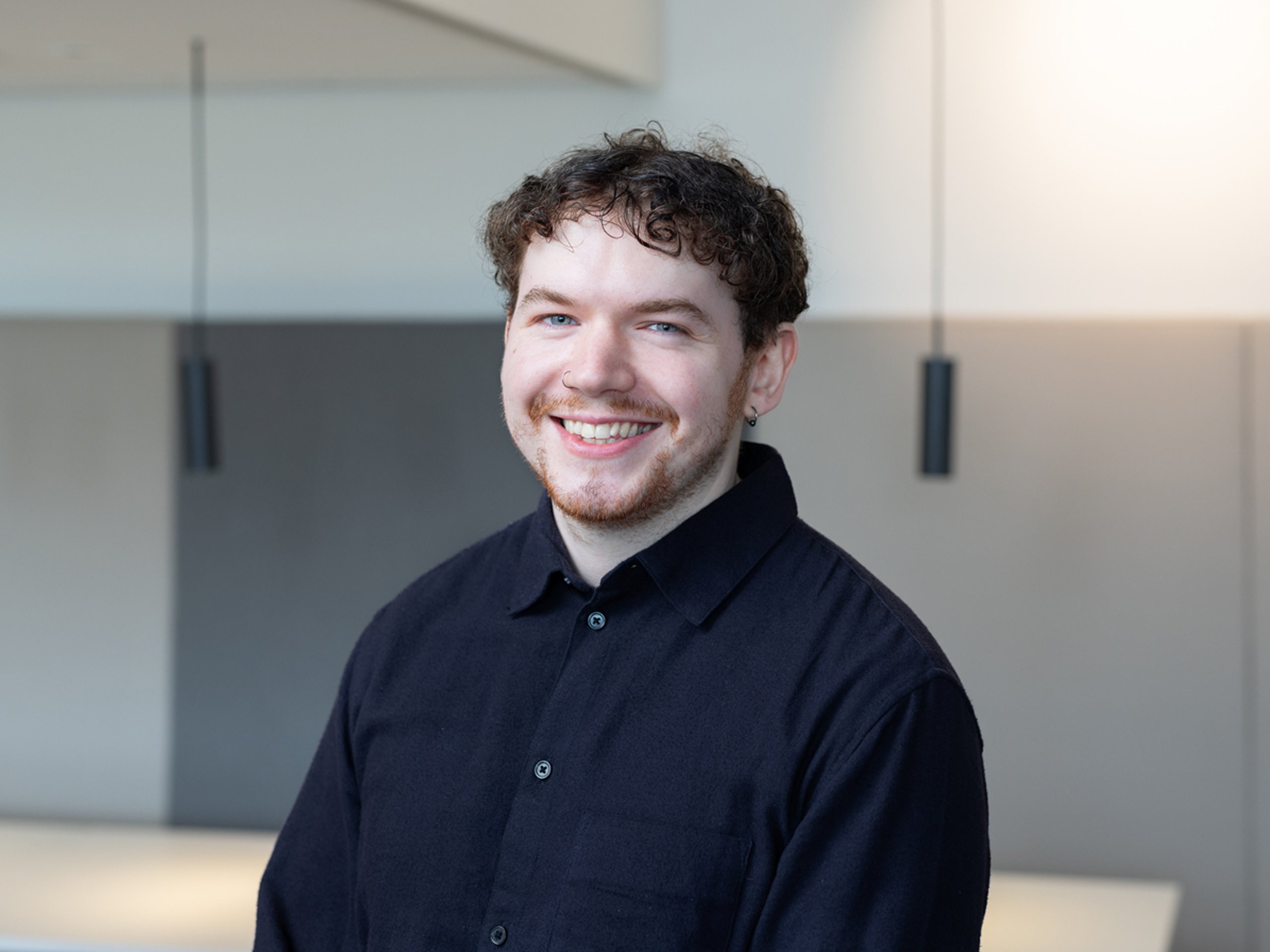
At the University of Amsterdam, Louis is developing compact, deployable trapped-ion hardware that works as a high-performance atomic clock. Trapped-ion systems are among the most precise quantum sensors available, thanks to their well-isolated environment and long coherence times.
But today’s versions are expensive, bulky, and largely stuck in research labs because of the complex optical and electronic infrastructure they require. Louis and his team want to change that by integrating photonics, electronics, and the ion trap itself into a radically smaller, commercially viable, and deployable device.
Accurate atomic clocks are the silent backbone of much of modern life. In defence, they give naval vessels and submarines more resilient navigation and timing, a capability that is only becoming more critical as GPS jamming and spoofing increase. In space, higher-precision clocks could enable more autonomous deep-space missions and sharpen satellite navigation systems. They are also vital to critical infrastructure, such as telecommunications networks and power grids, where precise, coordinated timing is non-negotiable. And they are important tools for atomic physics experiments, metrology and sovereign timekeeping.
Technical foundation
Some building blocks, including the ion-trap chip and its supporting electronics, are already fairly mature and have been extensively tested. The team is now developing novel integrated photonic chips to shrink the overall system. Within two years, Louis aims to have a proof-of-principle compact trapped-ion clock running in the lab, the technical foundation for a first minimum viable product.
The timing feels right to him. “Our research group has been interested in translating this technology into a commercially viable product for several years,” he says. “Over the past six months, we have concentrated increasingly on understanding the societal applications and potential customers, and we intend to incorporate our start-up within the next six months.”
Our research group has been interested in translating this technology into a commercially viable product for several years
His first months in the programme have been a real adjustment from his usual research routine. “Learning the fundamentals of market strategy and customer discovery has been invaluable, particularly in understanding how to determine whether a technology that works scientifically can also provide meaningful impact to customers.” Reaching out to potential users pushed him well outside his comfort zone, but has already taught him a great deal about communication, relationship-building, and seeing problems through the customer’s eyes.
Create value
Louis hopes to grow into a scientist-entrepreneur: someone who not only advances the technology but also grasps where it can create value and can assemble the team and organisation to deliver it. As a trained physicist, he brings a methodical, analytical approach to problem-solving, along with experience operating at the intersection of the fast-growing quantum and photonics sectors, where the customers, competitors, and stakeholders look quite different from those his peers encounter.
Louis is one of four new Faculty of Impact fellows we are introducing this month. Their fields could hardly be more different: solar optics, perovskite diagnostics, robotic touch and quantum timing. Yet all four are driven by the same conviction: that science earns its fullest meaning when it leaves the laboratory and reaches the people who need it. Meet Lisanne Einhaus, Agustin O. Alvarez and Alexander A. Oliva.

