‘I would say: copy, paste and get started’
18th of December 2025

Biotech Booster: a blueprint for valorisation in other domains
Supporting entrepreneurial researchers in bringing their academic discoveries to market. That is not only what drives the Faculty of Impact, it is also Biotech Booster’s main raison d’être. In 2022, the programme received 250 million euros from the National Growth Fund. For director Nettie Buitelaar, there can never be enough initiatives to increase the social impact of Dutch science. ‘We are completely complementary.’
Innovations in life sciences and biotechnology are crucial for both the future earning capacity of the Netherlands and the sustainability of healthcare. That is what former ASML CEO Peter Wennink emphasised last week in his National Investment Agenda. Internationally, we are still doing well in this field, but without targeted investments, we will quickly lose our leading position. What is needed, Wennink writes, is ‘a much more effective translation of scientific knowledge into commercial applications and scalable businesses’.
Promising ideas
That happens to be the main ambition of both the Faculty of Impact (for the entire scientific field) and Biotech Booster (focused on innovations in biotechnology). After securing a substantial amount of money in 2022, a chain-wide consortium got to work, with one of its goals being to provide funding and commercial guidance to over 50 promising early-stage biotech ideas each year. ‘And things have really taken off’, says director Nettie Buitelaar. ‘We have been operational since May 2024, and we now have 70+ projects in our programme. The high volume of applications allows us to be critical in selecting the most promising ones. Of course, given the long time-to-market in our sector, we are not yet at the stage where we can show real results in the form of spectacular exits. But we are definitely filling a gap.’
‘I can well imagine copying our approach to all domains of the National Technology Strategy, because it works’
A gift for the community
Buitelaar is equally enthusiastic about the nation-wide collaboration within the programme: ‘The fact that we are actively strengthening bridges between academia and industry, and sitting around the table with the entire field is already an important step. I notice that everyone recognises the overarching importance of this, which provides a great foundation for what we aim to achieve. First of all, we do that by providing financial support for promising projects, especially in the early phase when lack of funding is usually the bottleneck. At least as important is the fact that we built a national team of almost 40 business and impact developers working across all participating knowledge institutions. They are our eyes and ears in the field, scouting promising projects, serving as the first selection team, and sharing knowledge and lessons learned within and between those institutions. That is, of course, a gift to the academic community and the universities of applied sciences.’
Keeping the focus on business
It may be a gift, but these kinds of investments are also a dire necessity for our country’s future social earning capacity, as the Wennink report once again demonstrated. This starts with bridging the ‘first valley of death’ for all those promising inventions, which is the primary focus of initiatives such as Biotech Booster and Faculty of Impact. ‘This step has traditionally been insufficiently served’, says Buitelaar. ‘For regular investors, early-stage projects often haven’t advanced far enough just yet, and subsidised instruments for that early phase are relatively small and limited in availability.’ She considers it a significant advantage that applicants can submit projects to Biotech Booster while still working within knowledge institutions. ‘It’s an uncertain step: you have to quit your job without knowing whether you’ll ever make money from your idea. Within our programme, you test the waters first, while still earning a salary. That makes the step a lot less daunting.
Another success factor of the programme is the involvement of seasoned entrepreneurs in Dutch biotech or beyond. ‘They support participants by guiding projects, sharing their networks and helping them to keep the focus on the business. As scientists, we are trained to be completely certain about everything, but at some point, you need something you can take to market. Sometimes striving for perfection gets in the way of progress.’
Science for the people
It is no coincidence that this programme first took shape in biotechnology. Not only does it occupy a prominent place in the National Technology Strategy (NTS), but science and industry in this field have also been working together for quite some time. Nettie Buitelaar knows this better than anyone. At the beginning of this century, she was already leading Biopartner, a programme that received 100 million guilders from the Ministry of Economic Affairs to stimulate entrepreneurship in the life sciences. Later, she became the first director of Leiden Bio Science Park, a significant business and knowledge cluster in the life sciences in our country and a breeding ground for many biotech innovations. Since 2022, she has been CEO at Biotech Booster. ‘I have been working at these crossroads for a long time. Science must be there for people. In a serving role, we can help humanity progress further; that is both my personal conviction and inspiration.’
‘We provide financial support for promising projects, especially in the early phase when lack of funding is usually the bottleneck’
Of course, this is not limited to biotech. In an interview on this site, chair of the board at Vrije Universiteit Amsterdam, Margrethe Jonkman, said that, as far as she is concerned, the Biotech Booster model should be rolled out across five or six other areas in which the Netherlands excels. Buitelaar fully agrees. ‘I can well imagine copying our approach to all NTS domains, because it works. Looking at how much need there is in other areas, I would say: copy, paste and get started.’
Closer to the application
The amount of money available to Biotech Booster is, of course, a crucial precondition. Buitelaar therefore sees opportunities in Quantum Delta NL and Photondelta, for example, two areas in which substantial Growth Fund applications have also been approved. ‘They have more money than we do, but the difference is that they also have more science in their portfolio. We are the only ones who focus purely on valorisation; we start later in the chain and closer to application. Actually, that is exactly what the Growth Fund is intended for: ensuring that technologies effectively translate into societal and economic impact.’
It also means that much more mass is needed at the front end to fill the pipelines with ideas and people, as Margrethe Jonkman pointed out in her interview. That is one of the reasons why Buitelaar resolutely dismisses the idea that the Faculty of Impact and Biotech Booster are partly fishing in the same pond: she considers every initiative to promote valorisation to be urgently needed. ‘We are very complementary. At the Faculty of Impact, funds are distributed directly to researchers. At our level 1 (proof-of-principle projects), only one-third of the budget may be spent on personnel. And that cannot be permanent staff with a contract within a knowledge institution. You also see that some teams try to combine the two, which I believe is very smart.’
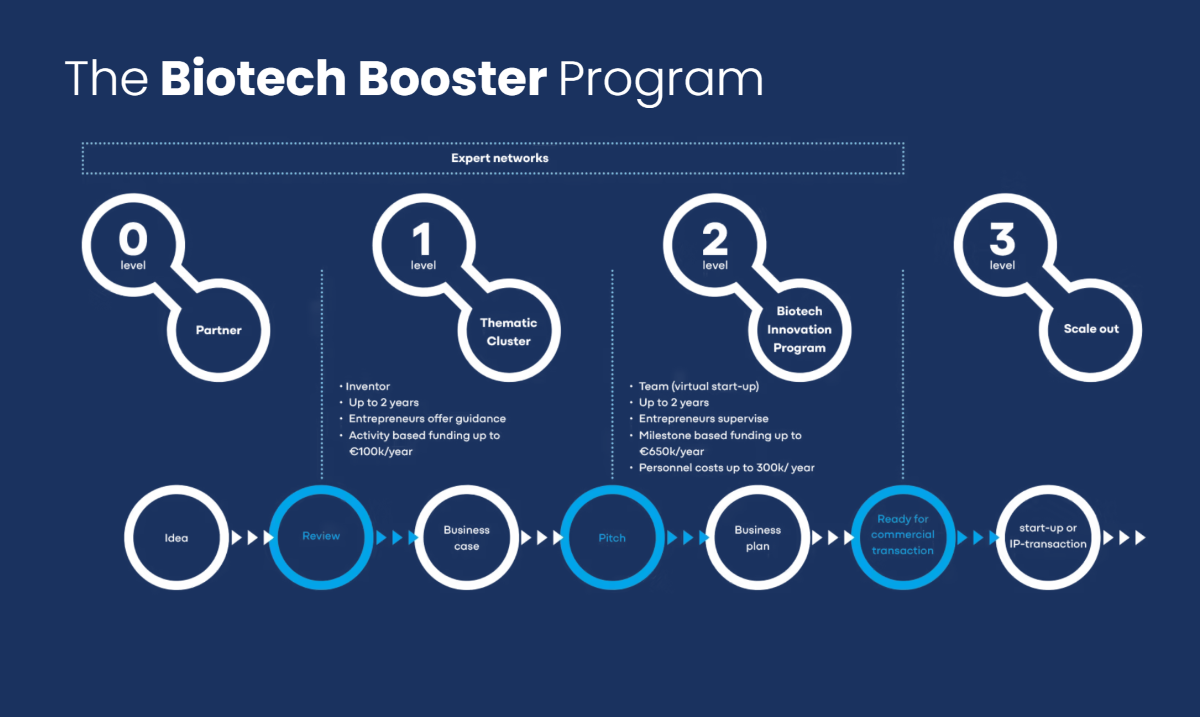
In any case, she says it is wise for start-up entrepreneurs to seek as much support as possible. ‘Test all the funding sources that may be available to you, including in combination with each other. You have no control over which ones you will receive and which you will not. For example, we get people who first did the Venture Challenge and then came to us, or vice versa. The same applies to NWO’s Take-off grant or the Faculty of Impact. There is no single best route; seize every opportunity you can.’
Joining forces for training needs
Like Margrethe Jonkman, Nettie Buitelaar also sees gains to be made if the various initiatives join forces even more. ‘It’s a shame if we duplicate efforts. For example, we are still exploring our training needs. But now that the BioBusiness Masterclass has been revived and the Faculty of Impact and the Venture Challenge are also looking to fulfil those educational needs, we will combine our efforts rather than go at it alone. You also see the same consultants coming back who are excellent at telling that story. We can integrate that even more, but we’re still refining how this works in practice.’
‘Let’s all combine our efforts rather than go at it alone’
After a gloomy period in which research investments were cut significantly and valorisation was put on the back burner, Buitelaar notices a shift in the political climate. ‘I am hopeful. We need to repair the damage that has been done. Everyone agrees that we have been going in the wrong direction and that we should turn things around by investing in innovation and valorisation. My hopes are high with the new coalition on the way. In the meantime, we will keep moving forward to demonstrate tangible results and show the returns on these investments.’

